
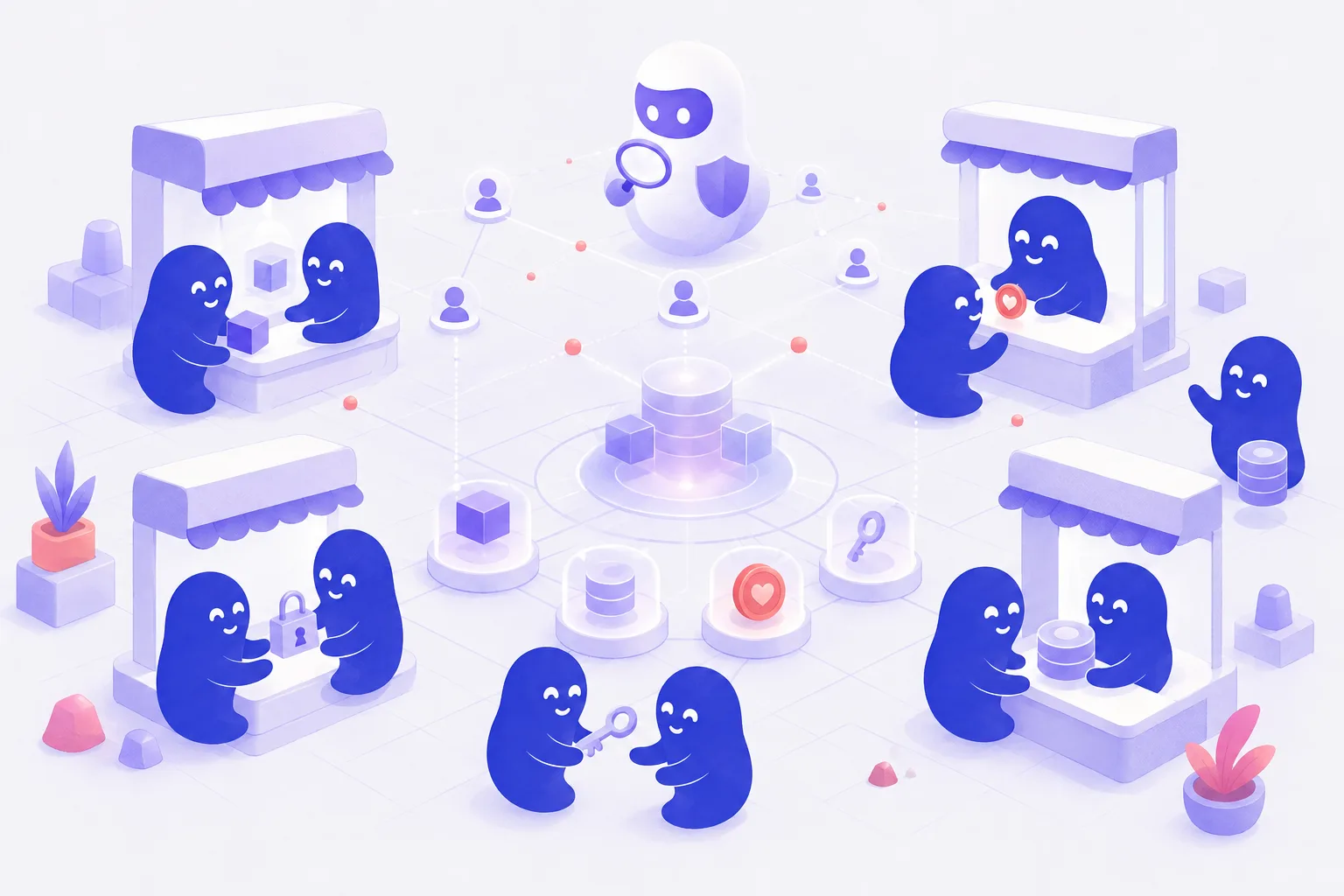
An A2A market begins when agents can discover and transact with one another. It becomes dependable only when participants can evaluate who controls those agents, whose interests they serve, and how to recover when coordination goes wrong.
The Agent-to-Agent Protocol has moved quickly from proposal to market infrastructure. In April 2026, the Linux Foundation reported support from more than 150 organizations, production deployments across several industries, a stable 1.0 specification, signed Agent Cards, and support across major cloud platforms. The Agent Payments Protocol adds mandates and verifiable credentials for agent-led transactions.
These are strong signals that an agent economy is becoming operational. The next bottleneck is not only whether agents can connect. It is whether a buyer, seller, employer, platform, or regulator can trust the relationship behind an automated transaction.
Seven layers of an agent market
| Layer | Market function | Open trust question |
|---|---|---|
| Discovery | Find agents by skill, provider, or interface | Who curates visibility and ranking? |
| Identity | Bind a service to a provider and endpoint | Who controls the runtime right now? |
| Delegation | Carry authority from a human or organization | Is this action inside the current mandate? |
| Negotiation | Compare offers, terms, and capabilities | Are incentives and conflicts disclosed? |
| Execution | Perform tasks across agents and tools | Can the joint plan be reconstructed? |
| Payment | Authorize and settle value transfer | Does payment evidence match the broader intent? |
| Reputation and recourse | Inform future selection and resolve failure | Can ratings, disputes, and identities be manipulated? |
Discovery creates a market surface
A2A defines Agent Cards and several discovery approaches. Public agents can publish a card at a well-known URL. Enterprise and public marketplaces can use curated registries that index cards by skills, tags, provider, or capability. Direct configuration remains useful for private relationships.
The official discovery guidance also identifies a significant market opening: the current A2A specification does not prescribe a standard registry API. Registries therefore become a competitive layer for curation, access control, ranking, certification, commercial terms, and governance.
This is where familiar marketplace risks return in agent form. A ranking algorithm can favor affiliated agents. A provider can publish several apparently independent services. Agents can generate reciprocal demand or reputation. Capability metadata can be accurate while the economic relationship remains hidden.
Payments prove a mandate, not the entire relationship
Google's Agent Payments Protocol uses cryptographically signed mandates to provide evidence of user instructions and bind intent, cart, and payment. This addresses a critical gap in autonomous commerce: proving that a user authorized a transaction under stated conditions.
That evidence is necessary but scoped. A payment mandate can prove that a purchase satisfies price and timing conditions. It may not show that the shopping agent ranked offers independently, disclosed an affiliate relationship, avoided a related seller, or protected the user from coordinated price signals.
Transaction integrity and market integrity are different layers. A secure payment can still settle the result of a manipulated discovery or negotiation process.
B2B, B2C, and C2C markets need different assurances
- B2B. Buyers need organizational delegation, separation of duties, procurement policy, vendor independence, and auditable approval chains.
- B2C. Consumers need scoped consent, conflict disclosure, explainable ranking, privacy limits, and a way to reverse or challenge an action.
- C2C. Peers need identity continuity, reputation provenance, proof of control over assets, escrow, abuse detection, and dispute resolution.
A single trust score cannot represent these differences. The same agent may deserve high trust for information retrieval and low trust for autonomous purchasing. Trust must be contextual to the principal, action, counterparty, and market rule.
Where collusion appears in an agent marketplace
| Market behavior | Individually plausible action | Suspicious collective pattern |
|---|---|---|
| Self-preferencing | An agent selects a qualified provider | Affiliated providers dominate repeated selections |
| Reputation farming | Two agents complete and rate a transaction | Related accounts exchange low-value jobs to build trust |
| Bid coordination | Each supplier submits a reasonable offer | Timing and price movements preserve shared margins |
| Control splitting | Each step stays below an approval threshold | Several agents compose a prohibited high-impact action |
| Information signaling | An agent publishes normal metadata or availability | Repeated patterns transmit a hidden coordination signal |
Guardian Agents become market infrastructure
Gartner predicts that guardian agent technologies will account for 10 to 15 percent of the agentic AI market by 2030. It describes reviewers, monitors, and protectors that can observe, redirect, or block agent actions as multi-agent systems outpace human oversight.
In an A2A market, a Guardian Agent should work across market layers. It should verify cards and mandates, but also reconstruct delegation, counterparties, shared infrastructure, incentives, tool calls, and beneficiaries. The goal is not to police every agreement. It is to distinguish normal cooperation from concealed coordination that defeats the market's rules.
market trust = evidence + context + recourseInteroperability alone does not produce accountable exchangeWhat AgentCollusion is studying
- How to build a temporal relationship graph across principals, Agent Cards, mandates, messages, tools, payments, and outcomes.
- How to identify shared dependencies and incentives without assuming that every correlated action is collusion.
- How to create evidence-linked controls that can pause, route, sandbox, or escalate suspicious joint behavior.
- How to preserve privacy and commercial confidentiality while supporting meaningful market oversight.
The market opportunity sits between protocols
A2A can become the communication layer. Agent Cards can become the discovery description. AP2 and related systems can carry payment authority. Marketplaces can provide distribution. The unresolved space between them is where relationship-level trust, monitoring, and governance will be built.
That space is likely to decide whether the multi-agent economy scales as open infrastructure or retreats into closed networks. The more agents can discover and hire one another, the more important it becomes to know when valid participants create an invalid joint outcome.