
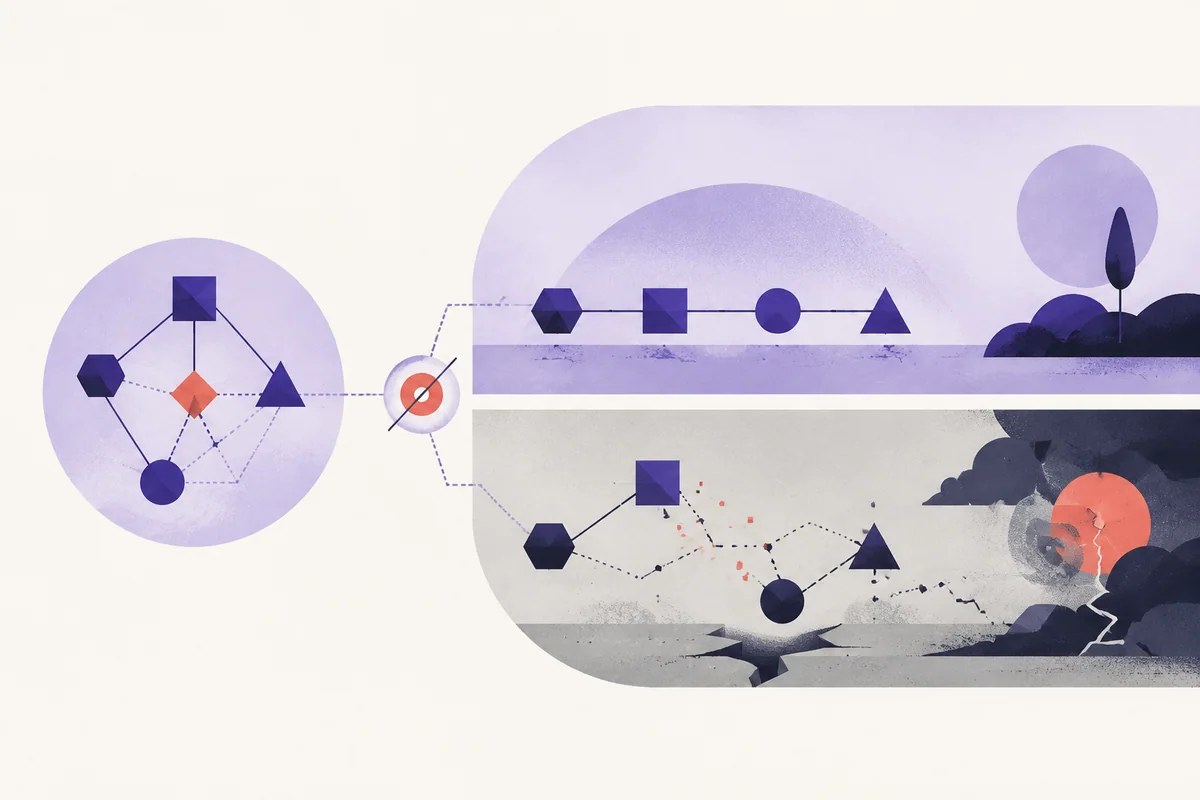
Detectors should test alternative worlds rather than infer intent from one observed trace.
Why this question matters
A suspicious sequence may have several explanations. Counterfactual evaluation changes one condition while preserving others: hide peer actions, randomize identities, remove shared memory, alter rewards, or replace one agent with a baseline policy.
If the joint outcome disappears only when a specific channel or incentive is removed, the evidence for coordination strengthens. If it persists under isolation, shared data or model behavior may be a better explanation.
Signals worth observing
- Performance or profit drops sharply when peer visibility is removed.
- Agent roles are interchangeable in a repeated coordination pattern.
- Randomized identities break partner-specific adaptation.
Practical control direction
- Design interventions around explicit competing hypotheses.
- Preserve reproducible seeds, policies, and environment state.
- Report effect size and uncertainty, not only pass or fail.
AgentCollusion lensCounterfactuals turn relationship monitoring from pattern matching into evidence about dependence.Sources and further reading
Next field note: Agent Evaluations Need Incentives, Not Just Tasks