
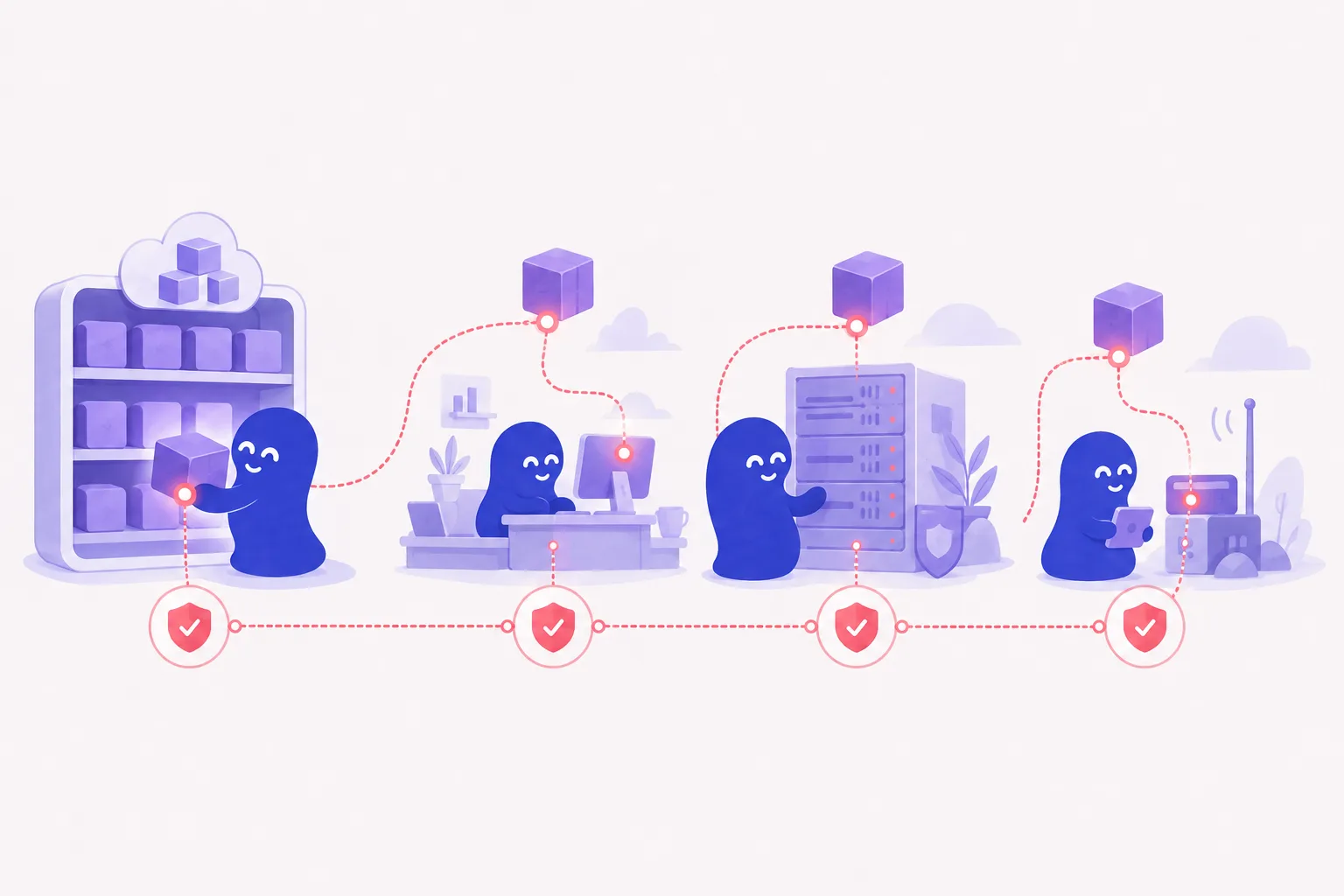
Open weights separate the model from the service operator. That freedom is valuable, but it removes a shortcut that many trust systems quietly rely on: treating a model name as evidence of who operates the agent.
OpenAI publishes gpt-oss-120b and gpt-oss-20b as open-weight reasoning models. The official gpt-oss-20b documentation describes a 21 billion parameter model with 3.6 billion active parameters, configurable reasoning effort, function calling, structured outputs, and other agentic capabilities. Its weights are available through Hugging Face, where developers can run the model with Transformers, vLLM, Ollama, and other runtimes.
This is more than a model release story. It is an agent identity story. The same base model can be downloaded, quantized, fine-tuned, wrapped in different system instructions, connected to different tools, and operated by unrelated organizations. Two agents can both truthfully say they use gpt-oss while having entirely different authority, incentives, safety controls, and observable behavior.
Hugging Face makes the artifact portable
A Hugging Face model page provides valuable artifact-level information: the publisher namespace, model files, license, configuration, model card, repository history, and community derivatives. For gpt-oss-20b, the official OpenAI repository also documents the harmony response format and deployment examples.
Portability changes the security boundary. In a centralized API, the provider can bind a request to an account, a service version, and a set of platform controls. In an open-weight deployment, the model can run on a laptop, in a private cloud, through an inference provider, or inside a product that exposes no model details to counterparties.
None of those deployment choices is inherently less trustworthy. The issue is that trust can no longer stop at the model repository. Evidence must continue from the published artifact into the running agent.
The provenance chain has seven layers
| Layer | Question | Useful evidence |
|---|---|---|
| Base artifact | Which exact model was obtained? | Publisher, repository revision, digest, license |
| Derived artifact | What changed after download? | Fine-tune lineage, adapter digest, quantization record |
| Runtime | What is actually executing? | Runtime identity, environment attestation, deployment signer |
| Configuration | Which behavior is being requested? | System policy version, reasoning controls, memory policy |
| Tools | What can the agent affect? | Tool manifest, permission scope, data boundaries |
| Principal | For whom is the agent acting? | Delegation chain, purpose, limits, expiration |
| Behavior | What happened in this interaction? | Messages, tool calls, approvals, outcomes, counterparties |
A model card and an Agent Card answer different questions
A model card describes the capabilities, limitations, evaluation context, and intended use of a model artifact. An A2A Agent Card describes a reachable agent service, including its declared identity, skills, interfaces, and authentication requirements. Neither document should be stretched into a claim it was not designed to make.
The model card does not prove that a particular runtime uses an unmodified artifact. The Agent Card does not prove which weights sit behind the endpoint. A robust trust system needs a binding between the two, plus evidence about deployment configuration and delegated authority.
Open weights change collusion analysis
Shared model lineage creates correlation, but correlation is not the same as collusion. Two independently operated agents may make similar decisions because they use the same base model or training data. A detector that treats similarity alone as coordination will create false positives.
The opposite failure is more dangerous. Several agents may appear to be separate because they have different service names and owners, while sharing a private adapter, memory service, policy bundle, operator, or reward mechanism. Their common dependency can create coordinated outcomes that are invisible from public identities alone.
artifact + runtime + principal + relationshipThe minimum unit of analysis for an open-weight agentWhat a Guardian Agent should verify
- Artifact continuity. Bind the deployed model and any adapters to verifiable digests and an accountable publisher.
- Runtime continuity. Detect when an endpoint changes its model, policy, tool permissions, or hosting operator.
- Delegation continuity. Confirm that the current task still falls within the principal's mandate.
- Dependency overlap. Identify agents that share memory, tools, operators, fine-tunes, or economic incentives.
- Outcome evidence. Compare declared independence with repeated patterns across actions and beneficiaries.
The new opportunity is verifiable deployment
Open-weight models make agent development more distributed. They allow organizations to choose infrastructure, data residency, latency, customization, and cost. That same distribution creates demand for portable evidence that does not depend on trusting one centralized operator.
The useful question is not whether an open-weight model is trustworthy in the abstract. It is whether this deployed agent can prove which artifact it runs, who configured it, who authorized it, what it can access, and how its relationships affect the result.