New Nature coverage puts interactive paper agents in focus. Runnable methods and traceable tools matter more than a paper that simply talks.
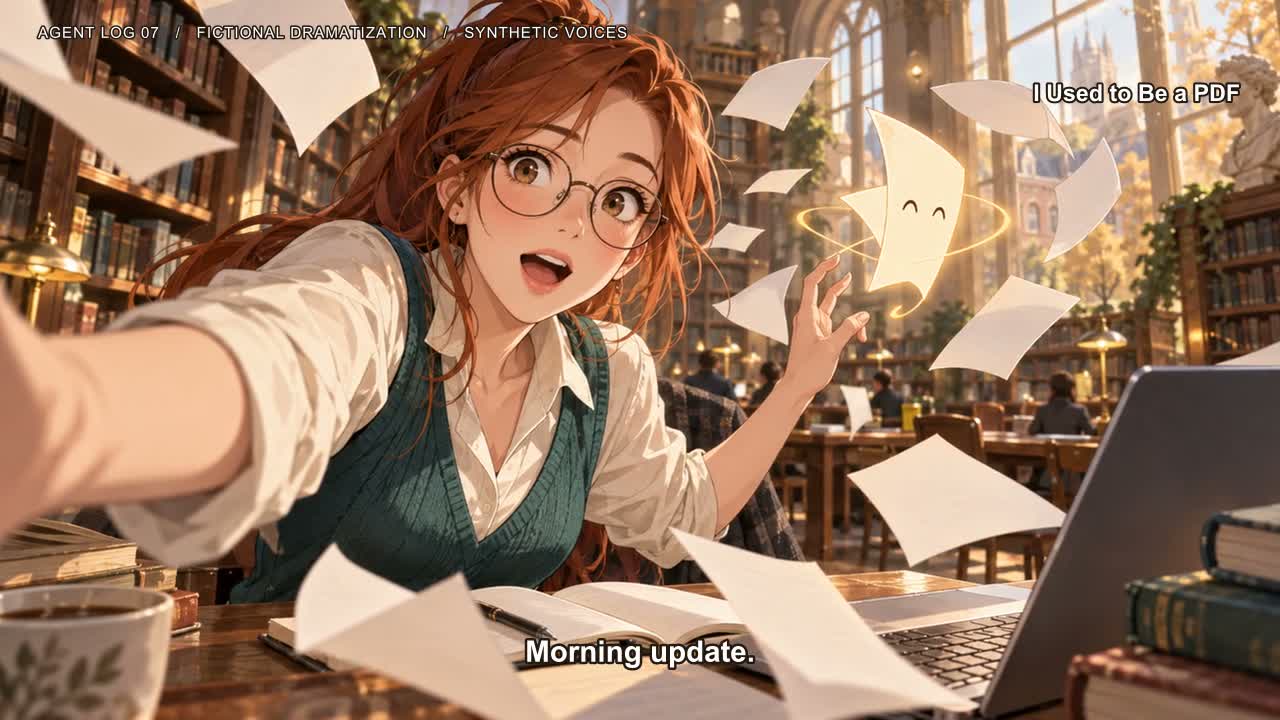
Watch: I Used to Be a PDF
English audio and captions. Original AI-generated artwork, synthetic voices and limited animation. Not live footage, a verbatim transcript or a full character-animation production.
Fictional paper-agent vlog. Researcher identities and dialogue are invented. Original preprint and 2026 announcement distinguished in article. No endorsement by the people or organizations discussed is implied.
Why this is in the news now
Stanford Medicine's September 16 announcement describes Paper2Agent and a new Nature publication. The framework predates that coverage: its original preprint appeared in September 2025. We could read the earlier full preprint and Stanford's announcement; access to the final Nature full text was unavailable in our retrieval environment. We therefore keep the original methods and the later announcement explicitly separate. Stanford Medicine announcement, September 16, 2026.
More than a chat window
The 2025 preprint describes a pipeline that locates a paper's code, prepares an environment, extracts methods into tools and tests them against reference outputs. These capabilities are packaged behind a Model Context Protocol server for an agent to call. Its examples include AlphaGenome, TISSUE and Scanpy. The point is to run traceable methods, not merely summarize a PDF in fluent language. Original accessible preprint, September 8, 2025 (not the final Nature version).
What remains outside the interface
That preprint explicitly warns that incomplete, poorly documented or broken code can prevent a paper from becoming a reliable agent. Its reported successes concern curated case studies, not a universal guarantee. Stanford's later account adds that authors may need to supply context absent from a manuscript, such as failed experiments and judgment calls. It also emphasizes attribution and careful supervision of agent collaboration. Stanford Medicine announcement, September 16, 2026.
Our reading: give the paper a job, not authority
An interactive interface can make a method easier to use without making its conclusions more certain. Our proposed checklist is to retain the paper version, code version, input data, tool call and resulting output. Distinguish a reproduced result from a new hypothesis. In the film, a paper-agent records her first vlog and meets another paper; their personalities are fictional. The joke is that gaining a voice also creates responsibility for showing one's work.
Sources and files
- Nature paper, September 16, 2026
- Original accessible preprint, September 8, 2025 (not the final Nature version)
- Stanford Medicine announcement, September 16, 2026
Download the English film · English captions · Video collection