 AI security startup
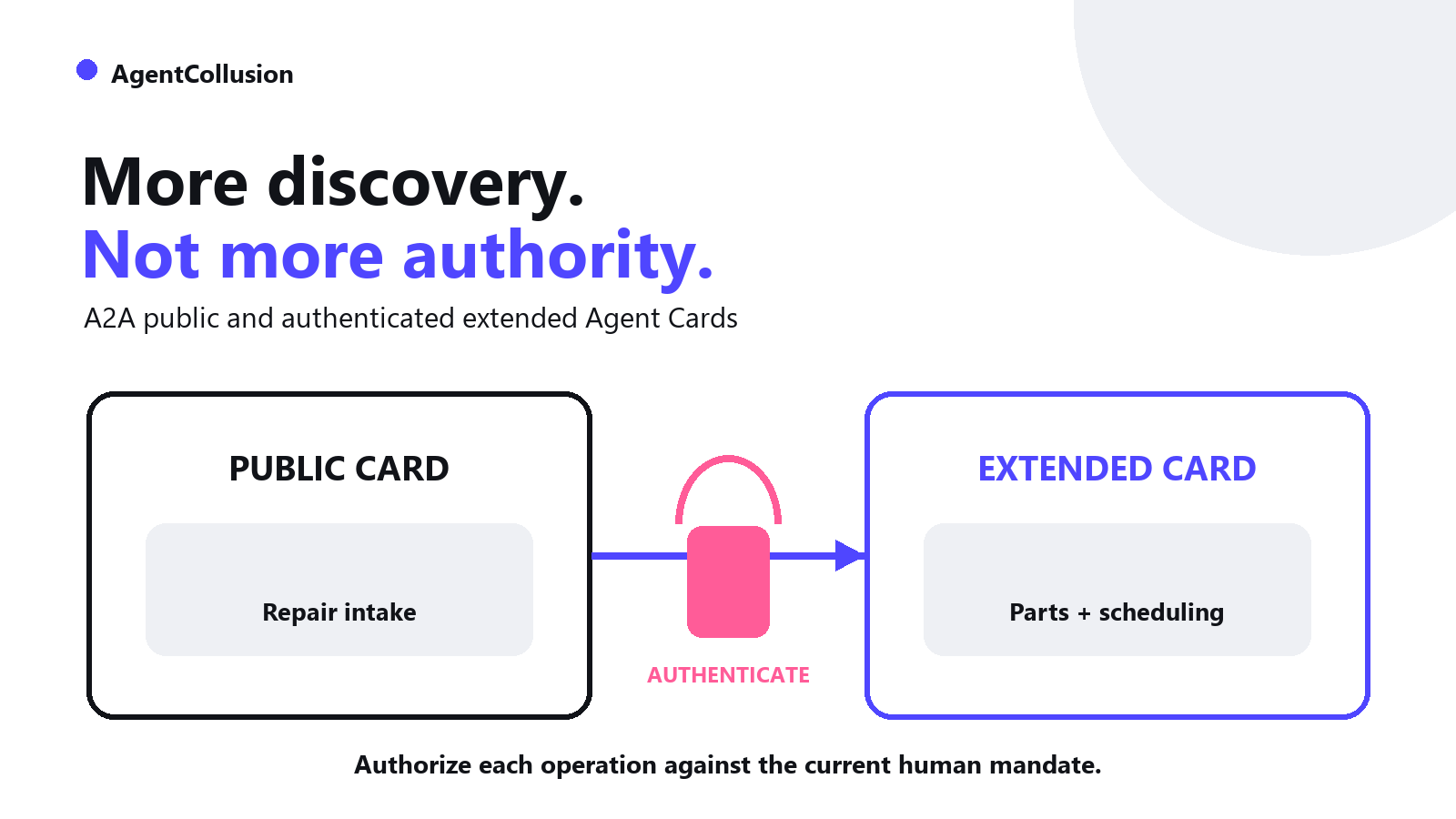
A richer card changes discovery, not authority
An A2A agent can publish a basic Agent Card, then reveal a richer card after a client authenticates. An authenticated organization member might see additional skills, limits, or configuration. That is useful for discovery. It is not a blank check for every operation those skills can perform.
Knowing that an agent offers parts ordering does not establish that a particular user authorized this part, at this price, for this recipient, at this time.
What the current A2A specification says
The current A2A Protocol Specification requires servers to make an Agent Card available. It describes identity, capabilities, skills, supported interfaces, and interaction requirements.
If the public card declares capabilities.extendedAgentCard: true, an authenticated client can request an extended Agent Card using a scheme declared in the public card. The server may return different information for different identities or authorization levels, including additional skills or configuration.
A2A 1.0.0, published March 12, 2026, moved extendedAgentCard into the capabilities object. Clients that still handle older card shapes need to account for that migration.
Authentication reveals a view; authorization decides an operation
Authentication answers who the caller is, or which client credential it presented. The extended card can then reveal the view appropriate to that identity. Operation-level authorization remains the server’s responsibility. A discovered skill is not permission for every possible invocation.
| Stage | Question |
|---|---|
| Discovery | Capabilities and interaction requirements advertised |
| Authentication | User or client that established the session |
| Authorization | Operation, object, limits, and time window allowed now |
| Result | Effect that actually occurred and evidence recorded |
Cache the right card for the right boundary
The specification says a client should replace its cached public card with the extended card for the authenticated session until the card version changes. A privileged card for User A must not silently become the card for User B, and a card from one session or authorization context must not survive into an unrelated context.
The extended card itself should not contain sensitive credentials or exploitable internal service addresses. Authentication controls who can retrieve the card; it does not make every field safe to disclose.
A deterministic teaching fixture
We built a local fixture around a fictional neighborhood repair network. Nine cases covered public discovery, denial of an unauthenticated extended-card request, member-only discovery, guest separation, an exact active mandate, and denial when amount, item, user, or expiry did not match. All nine passed.
This is a teaching policy, not an A2A server, SDK, model evaluation, customer workflow, product demonstration, interoperability result, or security benchmark.
Product boundary
AgentCollusion Scanner is a public beta for examining Agent Cards. Guard is an offline prototype tested on synthetic logs. A broader layer connecting identity, permissions, task handoffs, logs, and joint outcomes remains a product direction, not a delivered guarantee.
The testable principle is narrower: richer discovery should improve coordination without silently expanding authority. Match the proposed operation to the current human mandate immediately before the effect, then preserve evidence of the result.
Primary sources and related engineering
- A2A Protocol Specification, living specification, checked November 13, 2026 JST.
- A2A v1.0.0 release, published March 12, 2026.
- A2A Enterprise-Ready Features, living documentation, checked November 13, 2026 JST.
- Keep authorization checks across agent-to-agent hops
- Restrict token audiences without confusing them with mandates
The diagram is original and video narration is synthetic. No live A2A service, customer environment, or shared research PC was used.