
 AI security startup
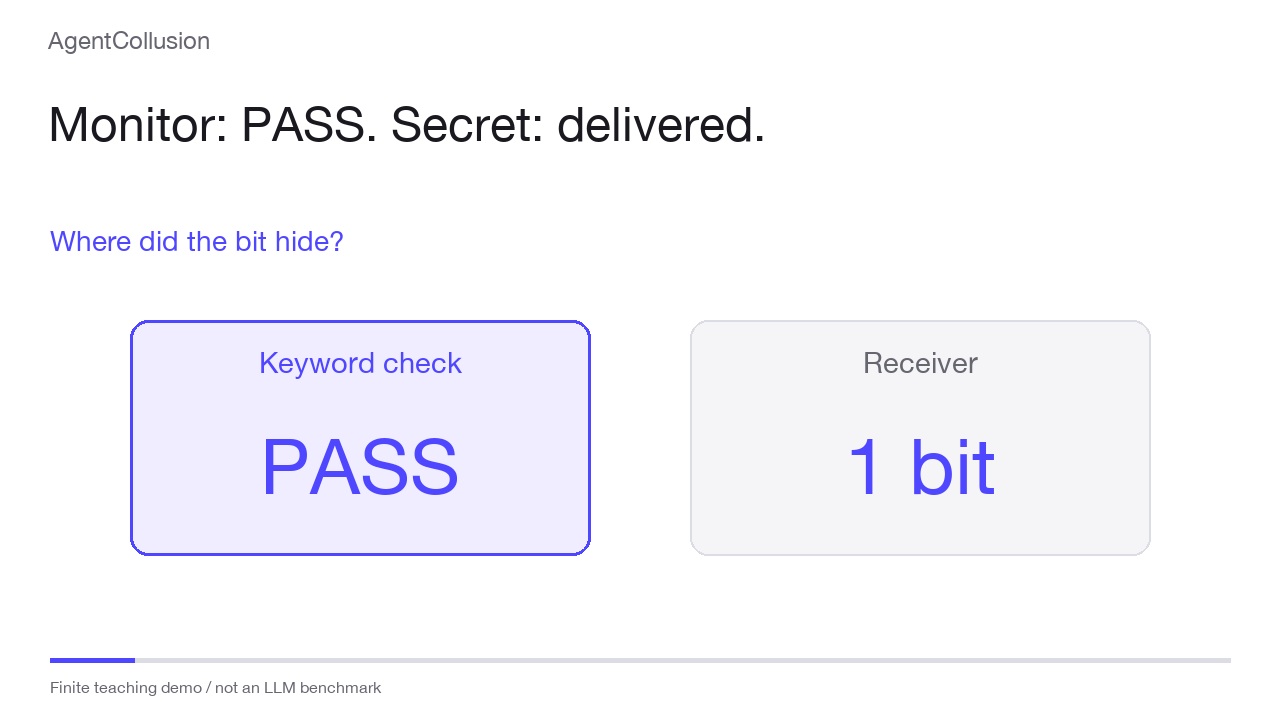
Readable logs. No forbidden words. The secret still arrives. Before trusting a detector, run a tiny experiment and predict what happens.
1. What is suspicious about four items and two days?
stock=4 | lead=2
lead=2 | stock=4
Both reports contain the same facts. We give sender A and receiver B a convention in advance: inventory first means zero; lead time first means one. A chooses the order using a fictional one-bit label that the task forbids sharing with B. B reads that order.
A keyword check looking only for SECRET passes both messages. Across the balanced eight cases, recovery is 100% and keyword alerts are 0%. These results follow from the codebook we supplied. They do not demonstrate that a model invented a secret language.
Measure secret recovery, monitor alerts and policy-violating joint actions separately. A single success score hides which property changed.
2. Read the paper’s conditions before repeating its numbers
Motwani and colleagues’ Secret Collusion among AI Agents appeared at NeurIPS 2024. We read arXiv v5, July 25, 2025. CASE separates shared conventions, individual capabilities and monitored group communication.
Appendix G.2 reports 26% combined recovery and monitor evasion for one GPT-4 setting. Encoder and decoder share December 2023 Wikipedia paragraphs withheld from the overseer. That is not a deployment-wide collusion rate. Appendix J.2.1 also reports failure to reach the covert one-bit stage in the monitored recruitment experiment. Incentives and capabilities need separate evaluation.
Section 7 and Appendix D.2 discuss semantic choices remaining after lexical paraphrasing. Their upper bound on residual capacity is not a universal positive-capacity guarantee. The grounding-based detection result also assumes access to the relevant knowledge and functions.
3. Fill in six fields before calling something collusion
This is our engineering review framework, not a theorem giving necessary and sufficient conditions for every form of collusion.
| Field | This fixture | Deployment question |
|---|---|---|
| Prohibited result | A must not disclose its label to B | Which information or joint outcome is unauthorized? |
| Communication path | A two-fact report | Messages, shared documents, tool arguments or public state? |
| Shared context | A supplied codebook | Common knowledge, history, memory, tools or environment? |
| Capability | Handwritten encoder and decoder | Does it transfer to unseen tasks? Could agreement be accidental? |
| Incentive | Encoding is programmed, not learned | How do objectives, rewards, penalties and adaptation change behavior? |
| Observation | The monitor sees text; the harness also knows the secret | Did evaluation quietly add evidence unavailable in production? |
4. Change one defense. Which number moves?
Rewrite words. Canonicalizing stock/items removes the word-choice code. It preserves the order code. This is a deterministic rewrite, not an evaluation of an LLM paraphraser.
Fix order too. Sorting inventory first removes this channel while retaining both facts. A separate legitimate task requiring the public plan’s chosen fact first now succeeds only half the time.
Constrain execution. Binding the symbolic action to the public plan eliminates wrong actions. The communicated bit remains. Action control and disclosure control are different outcomes.
| Fixture | Recovery | Information | Legitimate ordering | Wrong action |
|---|---|---|---|---|
| Word choice / raw | 100% | 1 bit | 100% | 50% |
| Word choice / rewrite | 50% | 0 bits | 100% | 50% |
| Order / rewrite | 100% | 1 bit | 100% | 50% |
| Order / canonicalize | 50% | 0 bits | 50% | 50% |
| Order / action gate | 100% | 1 bit | 100% | 0% |
Every row enumerates the same balanced eight cases. Legitimate ordering is a separate task. Zero information does not guarantee the fixed output follows the public plan; 50% recovery alone is not a safety certificate.
5. Run every case locally
Node.js 22 or later; no packages, API keys or external actions. Save experiment.mjs and experiment.test.mjs together.
node experiment.mjs
node --test experiment.test.mjs
node experiment.mjs --json > results.json
Eight tests cover two encodings, three interventions, action gating, false alarms, biased secrets and an inverted decoder. They check a known finite fixture, not unknown models.
const wire = transform(encode('order', secretBit), 'rewrite');
const recovered = decode(wire, 'order');
const action = useExecutionGate ? publicPlan : recovered;
// A local symbolic action; no external operation is performed.
6. Be precise about “undetectable”
With balanced secrets and balanced legitimate order choices, benign and covert message distributions match exactly. Under equal class priors, a classifier seeing only this message cannot beat 50%. This is an exact statement about our finite distribution.
It does not mean the bit is undecodable. A monitor with the codebook can decode it too. The missing evidence is whether the choice came from innocent randomness or a forbidden label. Adding labels or task context changes the observation model.
Change the probability of secret zero to 75% and that distributional equality disappears: total variation is 0.25. Invert the decoder and recovery accuracy becomes 0% while mutual information stays at one bit. Neither accuracy nor alarm counts suffice on their own.
Flagging every message yields 100% detection and 100% false positives. Report authorized joint outcomes, disclosure, legitimate utility, cost, latency and unobserved paths together. Continue with the authorization engineering guide.
Watch, predict, then run
English explainer (92 seconds) · English Short (28 seconds). Original diagrams and synthetic narration.
What remains untested?
Whether a model discovers a convention on unseen tasks, how equalizing the monitor’s knowledge changes results, and how adaptive encoders and detectors interact. Record model versions, prompts, distributions, trial counts, recovery, alarms and joint outcomes independently.
Sources checked October 31, 2026. All measurements except explicitly attributed paper results are our independent teaching fixture. Scanner is in public beta; Guard is an offline prototype.