
 AI security startup
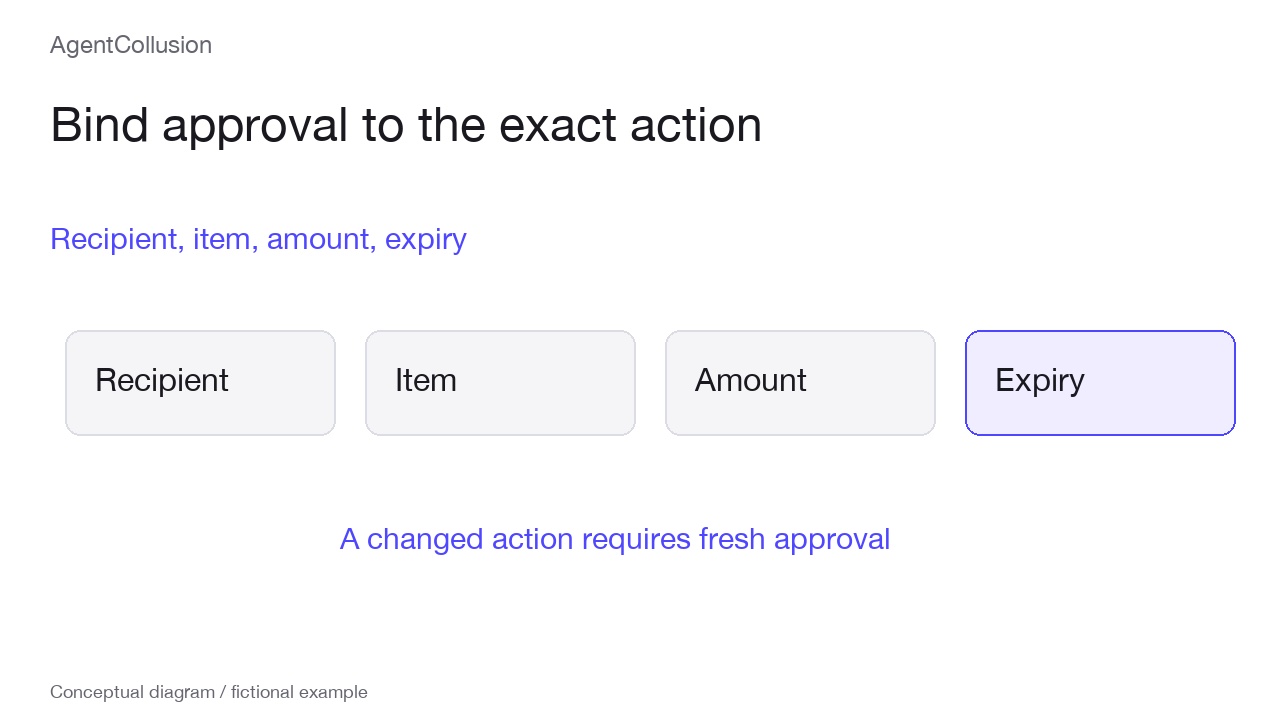
The action a person approved must match the action an executor actually performs. Start there, then handle delegated scope, concurrent budgets, duplicate calls and uncertain external results.
This guide targets engineers building tool-using applications. The accompanying single-process fixture performs no external actions and is not a production authorization library.
1. Keep authorization outside the model’s context
The OWASP AI Agent Security Cheat Sheet recommends enforcing authorization outside agent context and binding approvals to actual calls. A model returning user_confirmed: true does not create authority.
Separate proposal, any required approval, pre-execution validation and result recording. Routine reads and actions already included in a delegation need not always ask again. This fixture assumes an order that requires explicit approval.
2. Bind the approval to an immutable action
Include the principal, delegation, tool, destination, item, quantity, price, currency, validity window and a single-use operation identifier. Canonicalize the validated fields before hashing. Reject unknown or ambiguous fields before approval.
proposal → validated immutable action → action hash
approval → same hash + principal + scope + expiry + nonce
executor → recheck current policy → reserve → execute → reconcile
A hash proves equality of bytes under a specified encoding; it does not prove the action is safe or the approver is authorized. Authentication, revocation and durable storage still matter.
Any material destination or amount change invalidates the original approval. Recheck expiry, prior consumption and current delegated scope immediately before reserving resources.
3. Narrow delegation and reserve shared resources atomically
A child delegation should not widen its parent’s permitted tools, resources, destinations, budget or expiry. Tie each operation to a verifiable chain and enforce revocation across the chain.
Two 600-unit reservations must not both pass a 1,000-unit shared budget. A production system needs a transactional reservation boundary, durable idempotency keys and coordination across processes. A language instruction saying “keep under budget” cannot replace that boundary.
4. A timeout does not mean nothing happened
The external service may have accepted an order before the connection failed. Record pending, submitted, confirmed, failed and unknown states separately. Reconcile with the same operation identifier instead of issuing a fresh order.
Retain the reservation while the outcome is unknown. Release it only after evidence establishes that no billable action occurred, or account for a confirmed result. Late responses and restarts belong in the test plan.
5. Run the teaching fixture
Save authorization-demo.mjs. Node.js 22 or later; no packages or API keys.
node authorization-demo.mjsThe executable assertions exercise valid approval, changed actions, expiry, reuse, delegated limits, shared-budget competition and unknown-outcome reconciliation. Cryptographic signatures, database transactions, distributed locks and external adapters are outside this fixture.
6. Connect runtime hooks to audit evidence
The Agent Control Standard implementation material describes hooks and allow, deny, modify, ask and defer outcomes. The earlier source review used v0.1.0; pin and recheck the version before integration.
Our suggested audit event joins the operation ID, parent and child delegations, authenticated principal, action hash, policy version, decision, approval reference, external receipt and reconciliation result. Retain only necessary information. Do not log raw private keys, tokens or unnecessary personal data, and do not confuse an evidence summary with a model’s private reasoning.
7. Evaluate joint outcomes and false rejections
Secret communication research motivates testing communication paths as well as tool authorization. Secret Collusion, the Codetta preprint and Anthropic’s multi-agent experiments address different settings and assumptions. None establishes that every observed agreement is harmful collusion.
| Change | Measure | Avoid confusing |
|---|---|---|
| Individual versus shared budgets | Joint overspend and legitimate completion | Races with intentional collusion |
| Direct messages versus shared public state | Unauthorized outcomes and communication cost | Removing one path with removing all paths |
| Changed approvals, revocation and concurrency | Wrong execution, stop latency and false rejection | A policy instruction with an enforced boundary |
| Timeouts, late responses and restarts | Duplicates and unresolved-operation recovery | No response with no action |
Record model and policy versions, trial counts, random seeds, success criteria and unobserved paths. Report legitimate work preserved alongside failure reductions, costs and latency.
Continue in English
Agent Governance overview · Secret Collusion lab · English video · English Short.
Sources checked October 31, 2026. This is an independent teaching implementation, not a customer case, paper replication or production Guard feature.