
 AI security startup
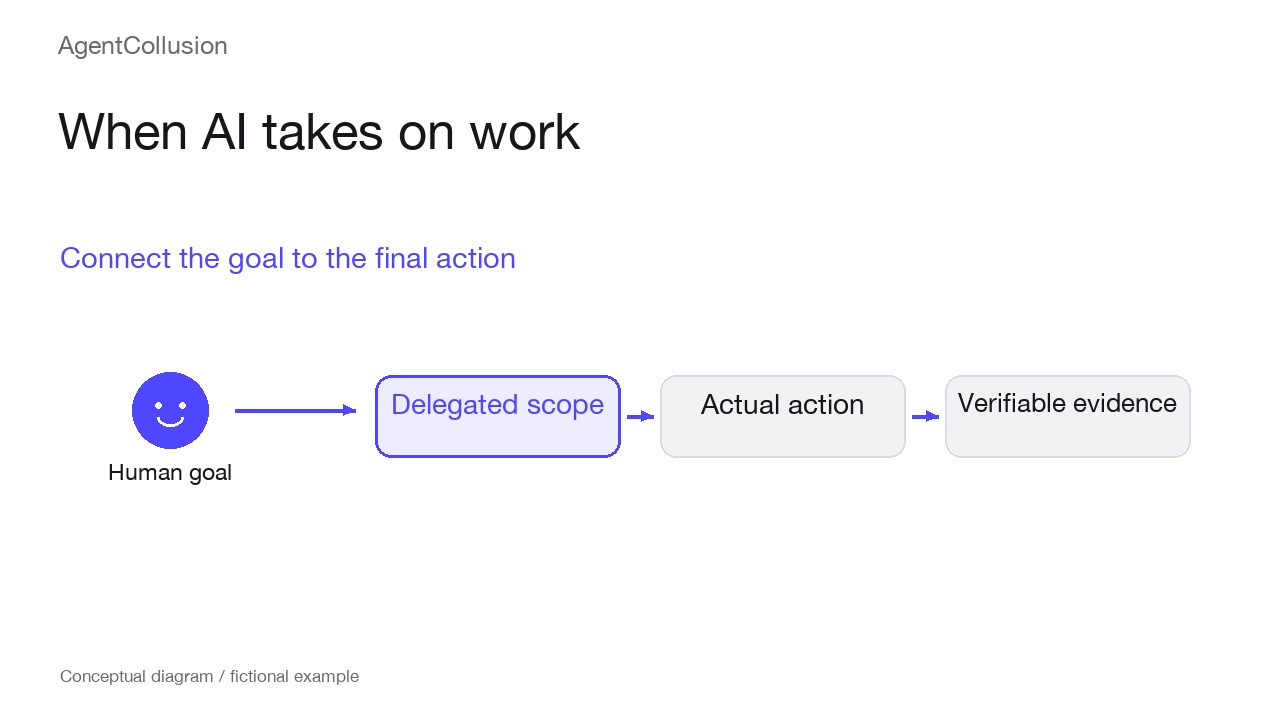
Agent governance connects whose goals an agent serves, the authority it carries, the actions it may execute and the evidence needed to stop or recover a workflow.
We use the term as an engineering and operating discipline, not a product name or certification. Start with organizational risk management, identity and delegation, then examine joint outcomes across agents.
Business rules still matter when AI operates the interface
Takayuki Saruta’s Japanese essay on why delegating work to AI increases the importance of SaaS argues that business rules, permissions, approvals and evidence remain valuable when agents operate the interface. It prompted this engineering overview; we do not rely on market forecasts.
Imagine an agent preparing a fictional repair event. It may read inventory and ask a specialist for advice. Preparing a quote does not authorize an order. Item identity, permitted records and the boundary between preparation and purchase must remain explicit.
Six questions for an implementation review
| Question | Evidence to retain |
|---|---|
| Who is acting? | Operator, agent and execution identity |
| What was delegated? | Purpose, resources, validity period and redelegation scope |
| What may it access? | Permissions per record, tool and destination |
| What is checked before execution? | Current conditions, limits and any required approval |
| What actually happened? | Decision evidence, external receipt and reconciliation |
| How can work stop and recover? | Revocation, holds and recovery procedures |
Governance should not force people to repeat the same permission for routine work already delegated. It should expose material changes in purpose, recipient, cost or publication scope.
Primary sources cover different layers
The NIST AI RMF Playbook organizes practices around Govern, Map, Measure and Manage. It is voluntary guidance, not a mandatory sequential checklist.
The NIST NCCoE identity and authorization comment summary discusses existing identity infrastructure, multi-hop delegation and audit evidence for authority. It summarizes submitted views; it does not certify the safety of each proposed mechanism.
OWASP’s agentic application risks and its AI Agent Security Cheat Sheet help translate these questions into application controls. Read their scope and version before treating guidance as an implemented control.
Two locally valid calls can exceed a shared budget
Give two agents a limit of 600 units each and a shared event budget of 1,000. Both 600-unit calls pass the individual check; their total is 1,200. The executor must reserve a common budget before execution and reconcile concurrent requests.
This is a race condition example, not evidence of intentional collusion. Evaluate failures of coordination and deliberately unauthorized coordination separately.
From delegation to executable controls
Bind approval to the exact action, enforce narrow delegation, prevent reuse, and preserve reservations while external outcomes are unknown. A model-produced approval flag is not authenticated evidence. Logging in successfully also does not establish authority for a new purchase.
Run the approval, budget and duplicate-action example →
Research adds communication and joint-outcome questions
Secret Collusion among AI Agents motivates examining concealed communication alongside incentives and capabilities. Useful collaboration itself is not proof of collusion. Vary objectives, delegation, communication and outcomes in controlled comparisons.
Try our independent Secret Collusion lab. Its deterministic measurements are neither paper reproductions nor production defense validation.
Watch in English
Delegation, approvals and shared budgets · Two agents. One budget. Original explanatory diagrams and synthetic narration.
Sources checked October 31, 2026. Scanner is in public beta; Guard is an offline prototype. Proposed controls are not claims about deployed customer outcomes.