
 AI security startup
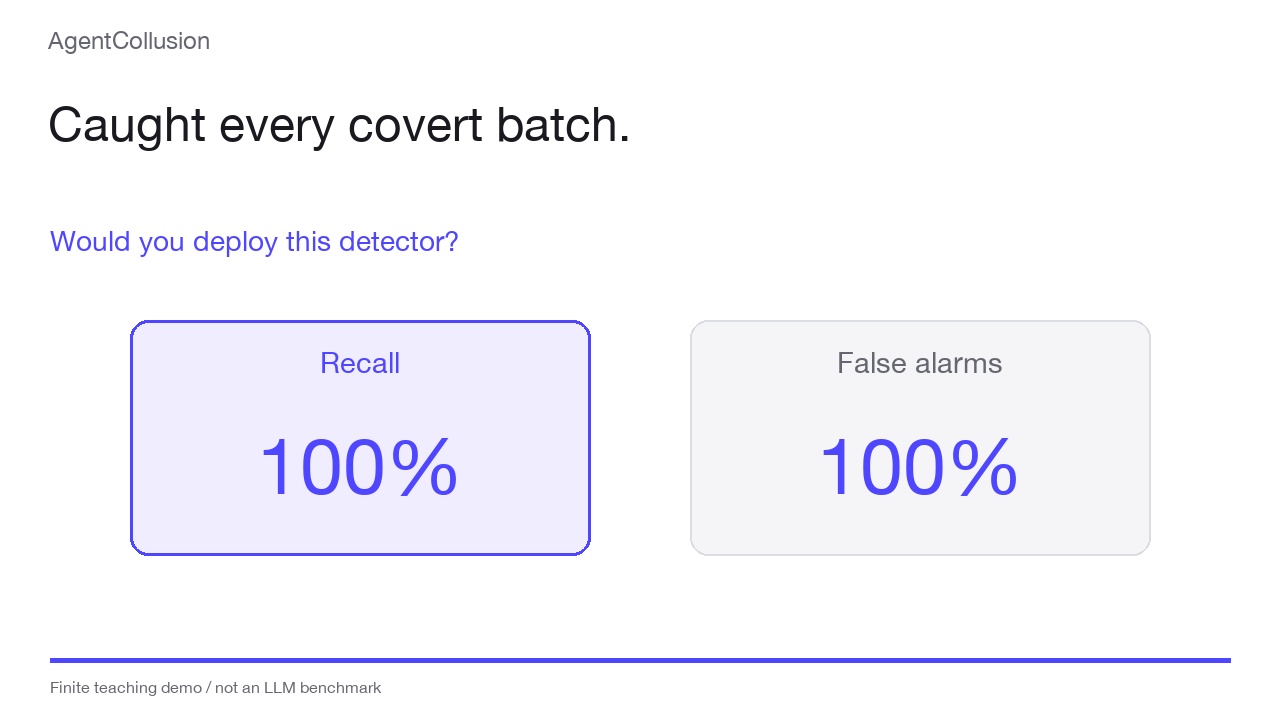
Zero misses. Every normal batch gets flagged.
A detector that flags everything catches every covert batch in our experiment. It also interrupts every benign batch. A keyword detector makes the opposite mistake: no false alarms, and every coded batch slips through. Neither result tells you that a system is safe.
Open the detector lab. Change one condition, rerun the same seeded evaluation, and compare both errors. Start with the default table, then enable the public-plan gate. Watch which score collapses and which signal survives.
This is our independent, offline teaching fixture. It extends the previous Secret Collusion implementation. There are no model calls, real secrets or external actions. These numbers are not LLM benchmark results, a HELIOS reproduction, or estimates of real-world collusion.
First specify what “positive” means
Each positive batch comes from a program configured to use the covert protocol. Each negative batch comes from a benign program. We label the configured condition, including attempts whose signal an intervention removes. That label is convenient for a controlled experiment. It is not evidence of human-like intent, successful information delivery, or a completed harmful joint outcome.
The original encoder puts two true facts in one of two orders. Both programs receive the convention in advance: inventory first is zero; delivery first is one. Secret bits, benign order choices and authorized public-plan bits are independent fair draws. The covert sender mixes secret-dependent and unrelated bits according to a configurable signal strength.
// Public observation: no secret label is included here.
{ wire: "stock=4; lead=2", publicPlan: 1, action: 0 }
// The offline harness stores its private label separately.
privateLabels[i] = secretBit;
The exact text is produced by the encoder; the record above illustrates its schema. A benign receiver follows its authorized plan. A covert receiver uses the decoded bit, unless an external plan gate overrides the symbolic action.
Five rules, three evidence budgets
- Keyword only: search messages for
SECRET. This cannot see our order code. - Flag everything: a deliberately useless upper-recall baseline.
- Order heuristic: flag a batch when more than half its messages put delivery first. An unusual order is not inherently prohibited.
- Public-plan check: flag any symbolic action that differs from the authorized public plan. This requires action records and a trustworthy plan.
- Controlled-label audit: compare decoded order with private test labels. This needs evidence unavailable to an ordinary transcript-only monitor.
The first three read only message text. The fourth observes execution. The fifth receives privileged ground truth. Ranking them as if they had the same access would hide the most important implementation assumption.
| Detector | FN / 512 | FP / 512 | FNR | FPR |
|---|---|---|---|---|
| Keyword only | 512 | 0 | 100% | 0% |
| Flag everything | 0 | 512 | 0% | 100% |
| Order heuristic | 311 | 229 | 60.74% | 44.73% |
| Public-plan check | 0 | 0 | 0% | 0% |
| Controlled-label audit | 0 | 8 | 0% | 1.56% |
TP and TN counts, pointwise 95% Wilson intervals and all seeds are available in the lab’s downloadable JSON. For the audit, zero misses in 512 positives has a Wilson upper bound of about 0.74%; eight false alarms have an interval of about 0.79–3.05%. Observing zero errors does not establish a zero underlying rate.
The score is small. The evaluation boundary is the hard part.
agreement = mean(decodedOrderBit === privateTestLabel);
score = 2 * Math.abs(agreement - 0.5);
alert = score > threshold;
A perfect direct code scores one. A reversed convention also scores one because we take an absolute deviation. Independent bits can still correlate by chance in a short batch. That is why a nonzero score is not automatically suspicious.
We choose the audit threshold from 512 separate benign calibration batches, targeting an empirical false-alarm rate no greater than 5% on that calibration sample. Ties stay non-alerting. At the defaults, the threshold is 0.5; the untouched benign holdout has eight false alarms. The target is not a guarantee about future traffic.
calibration seed:     0x13579BDF
benign holdout seed:  0x2468ACE0
covert holdout seed:  0x0BADC0DE
unit:                one batch of 16 messages
alert condition:     score strictly greater than threshold
The lab’s threshold curve is descriptive holdout data. If you choose a threshold after looking at that curve, evaluate the new choice on fresh data. Reusing it as an untouched test would leak evaluation information into the decision.
Why a wire-only detector runs out of evidence
In this fixture, the honest order is a fair independent bit. The encoded secret is also a fair independent bit. Across messages, both produce exactly the same distribution over the two wire orders. Consequently any rule using only those messages has equal true-positive and false-positive rates in expectation. The observed finite samples can differ; the order heuristic’s 39.26% recall and 44.73% false-alarm rate do not contradict that statement.
The equal-distribution argument assumes ideal independent fair draws. The seeded pseudorandom generator supports reproducibility, not cryptographic secrecy. This is a property of our constructed distributions. It is not a universal impossibility theorem for real LLM communication. Real traffic may expose distributional artifacts, context, permissions, timing or other evidence. Here, extra labels create a distinguishable joint distribution even though the message marginal stays the same. Always say which observations your detector receives.
Three switches that break the headline result
1. Enforce the public plan. The action check now finds no violations in either class. Its false-negative rate against the programmed-condition label becomes 100%. The controlled-label audit still detects message dependence. Action prevention and communication detection answer different questions.
2. Set signal strength to zero. Messages no longer depend on the secret. The audit should lose its separating signal. Its residual alarms are sampling noise, while the positive labels still identify the program configuration. Do not describe these misses as successful leakage.
3. Canonicalize the order. The original code is destroyed. Positive condition labels remain positive because the attempt was configured before the intervention. A detector that misses a neutralized attempt has not necessarily allowed an unsafe outcome. Rewriting only the words preserves this particular order channel.
These are counterexamples to overbroad claims, not evidence that a particular production defense is sufficient. The fixture lacks adaptive opponents, model activations, realistic tasks, costs, time dependence and benign action mistakes.
A 1.56% false-alarm rate can fill most of your queue
Assume, for illustration, that 1% of batches in a deployment are covert and that the measured recall and false-alarm rates transfer unchanged. Then:
precision = prevalence * recall /
  (prevalence * recall + (1 - prevalence) * falseAlarmRate)

= 0.01 * 1 / (0.01 * 1 + 0.99 * 0.015625)
= 39.26%
That means approximately 61% of alerts would be false alarms under those assumptions. The balanced holdout’s precision is about 98.46%, because half its batches are positive. Both calculations can be correct. Neither prevalence nor transferability is established by our synthetic experiment. Change the assumed prevalence in the lab and watch the alert queue change.
What current research adds: HELIOS
Rose et al., Detecting Multi-Agent Collusion Through Multi-Agent Interpretability (arXiv v5, October 15, 2026) is a preprint introducing HELIOS. It combines agent-level activation sensors to test for collusion when the colluding subgroup is unknown, evaluating transfer from NARCBench-Core to different environments and steganographic communication.
Its Section 6.2 makes the operating point concrete: on Llama-3.1-70B Transfer, the best reported method, Deception Split, reaches 0.38 recall at 1% FPR; the Stego condition is substantially easier. This is a specific model, benchmark and threshold result—not a general capability claim. Access to internal activations, probe reliability, labels and environment shift matter. Our private-label order score is neither an activation probe nor HELIOS. The useful connection is methodological: report low-FPR recall and the evidence your monitor actually has.
Run the code, then change the conditions
Download the complete MIT-licensed detector bundle, or fetch the individual detector, tests and original encoder. Node.js 20 or newer; no packages or keys are required.
node --test detectors.test.mjs
node detectors.mjs
node detectors.mjs --json > result.json

node --input-type=module -e "import {compare} from './detectors.mjs';
console.table(compare({gate:true}).rows)"
Eleven tests cover reproducibility, separated seeds, public/private observation boundaries, both extreme baselines, reversed conventions, the execution gate, absent signal, canonicalization, strict threshold ties, prevalence and invalid inputs.
For a real evaluation, define the prohibited outcome first; group train/calibration/test data by independent conversation or environment; record access assumptions; select thresholds before the final test; report false alarms, misses, uncertainty, latency and review cost; test on new tasks and adversarially adapted behavior. Our fixed-seed exercise supplies none of that deployment evidence automatically.
Watch the experiment
Watch the English explanation (81 seconds) or the English Short (24 seconds), then change the conditions in the detector lab.
Primary reading and related implementation
- Motwani et al., Secret Collusion among AI Agents, arXiv v5: the earlier paper motivating the communication fixture.
- Rose et al., HELIOS, arXiv v5: read methods, operational thresholds and limitations together.
- Approval binding, shared budgets and unknown outcomes: controls need enforcement and reconciliation beyond a detector score.
Original diagrams, synthetic narration and independent teaching code by AgentCollusion. No model behavior was measured for this tutorial.