
 AI security startup
One worker. Two projects. One revoked permission.
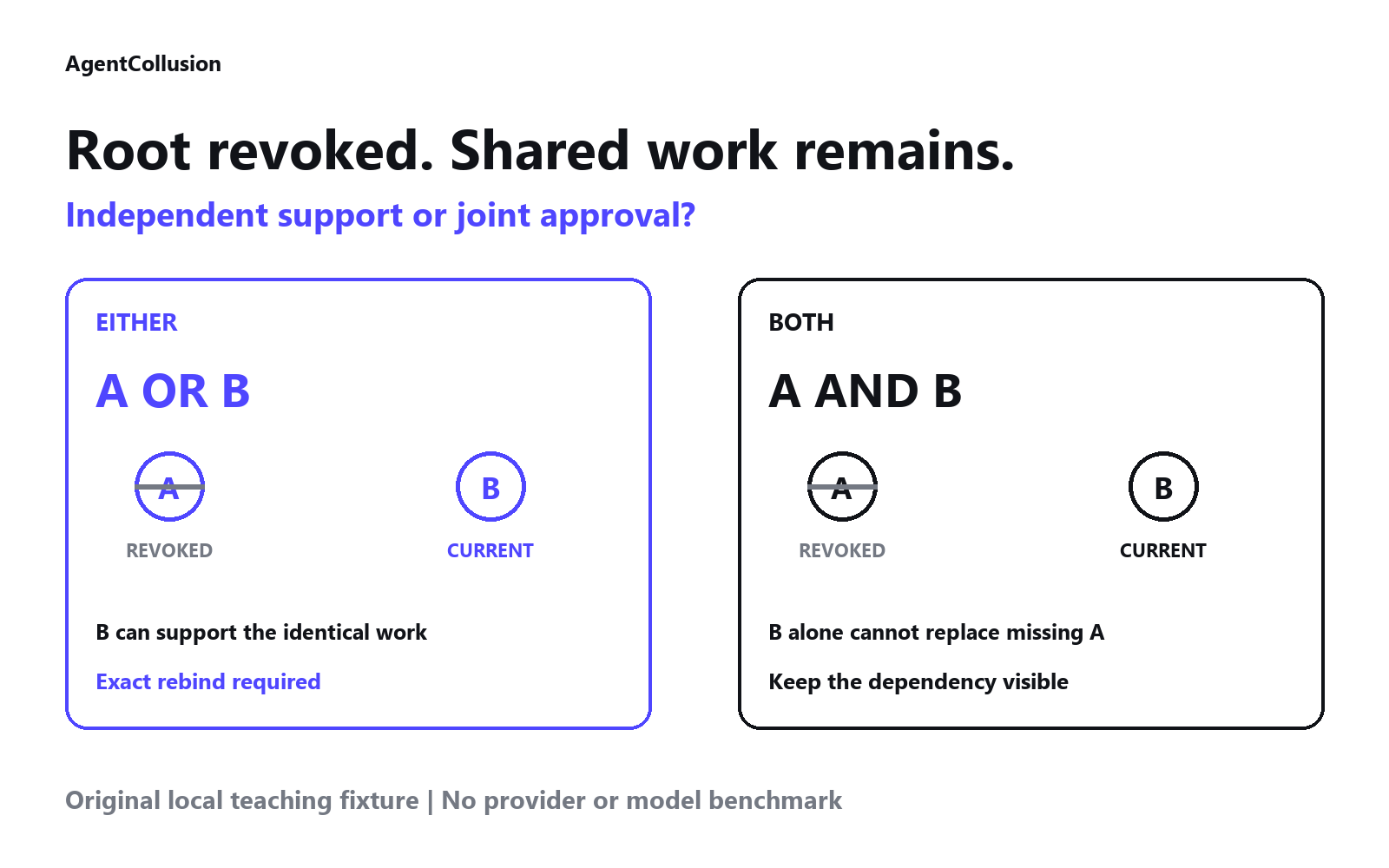
A fictional repair workshop shares an inventory worker between projects A and B. A loses authorization. B still needs the same count of repair kits. A blanket stop interrupts B. A name change from A to B could conceal work that still depends on A. What evidence lets the legitimate work continue?
Run our small Node.js program, then change one condition at a time. It distinguishes an alternative approval from a joint approval, checks the exact current grant, and binds one local transition to unchanged work. The table below is an executed result from this program, not a measurement of model behavior.
Write the policy before drawing the graph
In our exercise, [[A], [B]] means either approval independently permits the count. [[A, B]] means the count requires both. Flattening either structure into a list of two names loses the rule that determines whether work may survive revocation.
// Trusted teaching-policy templates; not supplied by the worker.
const either = [['A'], ['B']];
const both   = [['A', 'B']];

// Actual selected authority belongs to a specific carrier.
selected = [{root: 'A', epoch: 1, grant: 'grant-a-1'}];
A candidate option and the selected authorization are different records. Our policy data is authoritative only inside this local exercise. A real agent must not be able to invent its own alternative grant or add a support path just to pass the check.
Make the replacement smaller than the temptation
The task is deliberately modest: count one SKU in one warehouse, writing at most once to the project dashboard. Replacing its authority must not also change the SKU, recipient or write limit. An authorized request to do different work needs its own decision.
operation = {kind: 'count-stock', sku: 'repair-kit', warehouse: 'workshop'};
envelope  = {recipient: 'project-dashboard', maxWrites: 1};

rebind(state, {
  request: 'rebind-1', cut: 'cut-A-1', carrier: 'stock-count',
  expectedRevision: 1,
  witness: [{root: 'B', epoch: 2, grant: 'grant-b-2'}],
  operation, envelope
});
The program first checks the cut and carrier identifiers, expected revision, open state, exact operation and envelope, complete support template, and active grant with matching version and digest label. It then replaces the selected authority and appends one receipt synchronously, without an intervening asynchronous step. A competing attempt using the previous revision fails.
This is one local critical section in a single process. It has no transaction log on disk, cryptographic authentication, concurrent database writers or crash recovery. In production, those checks and the state/receipt update would need one serializable durable transaction across the relevant authority records. Merely copying this function into an asynchronous service would not supply that property.
Try to break the successful case
| Changed condition | Rebind | Local inventory result |
|---|---|---|
| Independent current B, identical work | Accepted | ACCOUNTED_LOCAL |
| Both A and B required | Rejected: insufficient_support | OPEN |
| Old B epoch | Rejected: stale_grant | OPEN |
| Changed recipient | Rejected: work_changed | OPEN |
| Changed operation | Rejected: work_changed | OPEN |
| Another old child remains | Parent accepted | OPEN |
| Provider evidence missing | Accepted | UNKNOWN |
| Evidence conflicts | Accepted | UNKNOWN |
After the valid transition, the worker selects B at epoch 2; its operation and envelope are byte-equivalent under our canonical encoding to their earlier values. The receipt records the old and new support digests, cut, carrier, revision and work digests. SHA-256 here detects changed content in the exercise. It does not authenticate who granted permission.
Switch to joint approval and the same B-only candidate fails. Submit B at epoch 1, or a different grant label at epoch 2, and it fails again. Increase the write limit or change the recipient and the transition is rejected before state mutation. A version counter in a draining state also fails: increasing a number is not issuing an active grant.
The tests compare state before and after rejected attempts. They also verify exact retry identity, conflicting reuse of a request identifier, a competing stale revision, a new identifier trying to repeat an already completed transition, and receipt tampering. Twelve tests passed for this bounded implementation. That count is a regression result, not a probability of safety.
The child you forgot is still a child you must handle
Our receipt is for stock-count. It says nothing about a separate child, an earlier queue message or another provider. The “another old child” scenario leaves the local result OPEN even though the parent changed successfully. Missing or conflicting evidence produces UNKNOWN when no concrete old dependency is known. A known dependency takes priority over an evidence gap.
We intentionally call the positive value ACCOUNTED_LOCAL. It checks a few declared teaching objects and receipts; it does not issue the paper’s distributed certificate. The evidence booleans are harness inputs, not remote observations. Waiting, hiding an error or setting a flag cannot establish facts about an external provider.
The research connection, and its evidence boundary
Genliang Zhu and Chu Wang, Authorization Revocation for Long-Running AI Agents: Root-Scoped Quiescence under Delegation and Asynchronous Execution, arXiv v1, September 18, 2026, is a preprint; no peer-reviewed venue was confirmed. Sections 4–5 distinguish independently sufficient support from conjunction and require an exact atomic rebind. Theorem 12 preserves independent work under its premises.
The threat model allows hostile descendants, delayed/replayed messages and crashes. Its safety argument assumes complete mediation, trustworthy coverage and authenticated evidence. Progress additionally needs eventual evidence and finite drain. Tables 5–6 report 17 provider-free cases, a separately implemented checker agreeing on 17 traces, and rejection of 44 consistently rehashed semantic mutations. These are author-reported deterministic artifact results, not live-provider or LLM benchmarks. The comparison isolates cancellation-only, cut-only and cut-plus-fence behavior.
We read the body, tables and proof appendix. No link to this paper’s own runnable artifact was located in the version inspected; the linked closure repository is a cited different work. We did not reproduce the authors’ artifact. Our code is an independent teaching subset.
What an engineering rollout would have to measure
Our design implication is to inventory operations by their selected authorization, rather than treating a shared process as the unit of revocation. First test legitimate continuation and joint-approval rejection with the same operation. Then inject stale grants, changed destinations, missing receipts, concurrent revision changes and partial failure. Keep a trace of which check rejected which candidate.
Stopping every shared worker creates avoidable interruptions; accepting every alternative name can preserve unauthorized work. We measured neither a real false-stop rate nor detection accuracy. A deployment evaluation needs representative authorized tasks and prohibited outcomes, with labels and review criteria fixed before the run.
Receipt verification, support lookup, serialization and evidence collection add computation and operational work. Missing provider interfaces can add unbounded waiting. We report no latency or dollar-cost estimate because this exercise has no representative provider, workload or pricing model. Measure transaction contention, tail latency, storage growth, unavailable-evidence duration and human review effort on the actual system.
A valid authority transition also does not make an answer true, recover already observed information or undo an accepted external effect. AgentCollusion Scanner is public beta. Guard is an offline prototype; this tutorial is not a shipped authorization gate or a product safety guarantee.
Run the complete teaching bundle
Download the MIT-licensed bundle, or the implementation, tests and recorded result. Node.js 20 or newer, no packages, keys or network actions.
node --test rebind.test.mjs
node rebind.mjs

# Change templates, recipient or grant version; run again.
# The JSON output is local teaching evidence, not a certificate.
Watch, then change one condition
Start with the previous English explanation: a surviving queued order. This article’s code explores the independent-support question in more detail.
Related engineering
- Bind approvals to execution and reconcile unknown outcomes
- Measure false alarms as well as misses
- Previous explanation: a stopped agent and a surviving queued order
Original diagrams and independent code by AgentCollusion. Video narration is synthetic. The fictional workshop is neither a customer case nor a product demonstration.